Showing posts with label RL Championships. Show all posts

7 September 2017

Structuring the Future: a different way forward for Rugby League

Changes are coming in 2019 it seems. As ever, views are split and no-one agrees. But all the ideas I've seen are things that we've seen before already - a load of tried, tested, moaned about and moved on from structures.

Personally I'd stick as we are, with very minor tweaks, but if change is in the air my suggestion is one we haven't tried yet, but is hugely successful in America. Here it is!
--------------------------------------
Super League
  • Super League to be made up of two conferences of 8 each
  • Sides play within their conference home and away (14 games)
  • Sides play inter-conference opponents once - rotating the home/away game in alternating years (8 games)
  • Magic Weekend will see sides play the other conference side who ended the previous year in the same position, i.e. 1v1, 2v2 etc. (1 game)
  • Playoffs: 1v4 and 2v3 in each conference, winners playoff in conference finals, then winner of each conference play Grand Final.
  • Promotion & Relegation can be retained, if desired, by having the bottom side of each conference playoff. They would be replaced by the winner of a Championship Grand Final. (I wouldn't allow P&R in Year 1, to let things settle)
Here's an idea of how it might look, based on current league placings and ability to run as full time clubs in 2019. I'm not a marketing guy, so the conference names are just me spit-balling, but you get the idea.
One thing you'll notice from this structure is there's a lot less games than we currently play. Super League sides currently play 23 regular season games, 7 'Super 8s' games, then potentially a semi and a Grand Final. 30 to 32 games, plus up to 5 in the Cup. In my structure they play 23 league games, then potentially 3 finals games, as well as up to 5 Cup games.

That opens up the schedule for some extra games. Those games could be:
  • Additional 'On the Road' rounds, as part of the actual season of course - inter-conference games between say the top 4 from each and bottom 4 from each, other than your Magic opponent, so 3 more regular season games. They could be played as double headers in places like the Midlands, London, South West, Cardiff, Dublin, Edinburgh etc.
  • An expanded World Club Series (although we might struggle to get NRL buy-in!)
  • International games, with France, New Zealand or Pacific Island nations all possibilities.
  • An Origin Series - Lancashire v Yorkshire, with Cumbria v the South or something as a curtain raiser.
  • You could also work in an 'All-Star' game, with players from each conference other than the Grand Final sides, as a Grand Final curtain raiser maybe, to further encourage fans of all sides to attend.
--------------------------------------
Championship

At the moment I'm not convinced we have the depth of quality below the full time clubs to have the same structure in the Championship as in the Super League.

I would suggest for the Championship:
  • A 12 team league, featuring based on current clubs and current standings:
    • Featherstone, Halifax, Batley, Sheffield, Dewsbury, Rochdale, Swinton, Oldham, Bradford, Barrow, Whitehaven, York
  • Top 4 playoff, 1v4 and 2v3, followed by promotion final at neutral venue - potentially as Super League Grand Final curtain raiser or part of some other 'event'.
  • Bottom side will go down to League 1.
  • Fixtures would be made up of:
    • Home & away v all (22 games)
    • 'Summer Bash' fixture against closest finishing opponent previous year (i.e. relegated side v final loser, losing semi finalists, 5v6, 7v8 etc.) (23 games)
  • I would strongly consider reinstating a cup competition for this level if clubs feel 11 home fixtures isn't enough to sustain required revenue levels to compete.
--------------------------------------
League 1

It's really tough to make a call on what to do with League 1 right now, with a some uncertainty surrounding the existing clubs like All Golds and Oxford.

If we assume no change for now, we're left with 12 teams: Doncaster, Keighley, Newcastle, Workington, London Skolars, Hunslet, North Wales, All Golds, Coventry, Oxford, Hemel and South Wales.

The obvious solution is to copy the Championship set up. That would work well in some ways, but with such low central funding - and crowds - at this level, I think it needs a unique solution given the distances travelled. 

I would have a north and a south division, with inter-division play, to help the Southern teams progress still. 
  • Sides would play their own division 3 times, with 7 home games, 7 away games and 1 to be decided - it could be neutral for example. (15 games)
  • Sides would play once against the other division - 3 home and 3 away, based on odd or even finishing position the year before. (6 games)
  • The playoffs would consist of 3 North sides, to reflect their generally stronger capability to compete if promoted, and 2 South sides. The top finishing North side gets a 1st round bye. In the 1st round QF1 sees South 1 hosts North 2, and QF2 sees South 2 hosts North 3. In the 2nd round, SF1 sees North 1 hosts winner of QF1, and SF2 sees loser QF1 hosts winner QF2. In the 3rd round, Loser SF1 hosts winner SF2 for the right to face winner SF1 in the Promotion Final. 
  • With Promotion & Relegation to/from the Championship, the make up of the divisions will have to be fluid.
It would look something like this:
--------------------------------------
Entry to the League

New entrants can enter in one of three ways. All have to be approved by a majority of member clubs.

  1. Application to join League 1 as a new part-time club. They join the most appropriate division and fixture scheduling is adjusted as appropriate. No club will be forced from the structure. 
  2. Application to join Championship as a full-time club. Their will be a requirement to financially compensate the club displaced into League 1. No club will be forced from the structure.
  3. Buy-out an existing club at any level, directly replacing that club in the structure.
I would say 1 & 2 type of entrants need to be ratified by kick off of the season before the one where entry would occur, to allow for confirmation on any structural adjustments. Type 3 entrants will need to be ratified by Super League Grand Final day of the season before the one where the entry/change will occur.
--------------------------------------

Anyway, that's my idea, if we have to change things. I actually think you could apply my Super League structure to the NRL too. Let me know your ideas too!

Mark
SLP

7 February 2017

Rugby League Hierarchy - An Idea For The Way Forward

In my often stated opinion, the NFL is the best run pro sports league in the world. It isn't without it's issues I'll admit, but it leaves the way the Super League is run languishing way in the distance.

I'm not a token Red Hall basher. I think the people that run the sport genuinely care about the game, at all levels, and want it to progress. They have made and continue to make mistakes though. And they aren't always helped by the clubs, which aren't always particularly well run either and don't always look out for the interests of the game as a whole, sadly.

A big part of the problems and difficulties to me comes from the organisation that fronts our professional game also fronts our international side and our community game. I understand there will be degrees of separation, but the RFL sits at the top of it all and I'm certain nothing significant would go through without their stamp of approval. In my opinion, a whole game approach can be achieved successfully without hands on RFL involvement in all aspects.

The other big part of the problem to me, looking in from the periphery, is that clubs generally compete with each other first and support each other second.

I have an idea, of sorts, on how to address these feelings and concerns I have. Separate the professional game and the amateur game more decisively. Have the RFL run the wider community game, control the Challenge Cup still and oversee the international game in the UK, but take Super League and the Championship/League 1 out of their hands, to be run by the clubs. All the clubs.

I'm not suggesting the RFL wouldn't still have a seat at that table, they just wouldn't preside over it.

I feel that if you make the owners/executives of the clubs equally responsible for the professional game then they will work harder together to increase the size of the pie, rather than compete with each other or against the RFL for just a larger slice of the pie currently being served.

You would and should insist as part of the charter of this newly reinforced professional arm of the game that a certain proportion of the pie gets handed over to the RFL for their work in the community game. Similarly, revenues from the Cup final and internationals can be shared equitably from the other direction. You would also insist clubs have an in built responsibility for giving up a certain amount of their full time resources to local community initiatives.

Crucially though, the clubs would all get to play a part in moving the professional game forward, without wider political forces influencing decision making.

They would still, in some capacity, answer to the RFL and the wider interests of the sport. But, importantly, the RFL would also answer to the professional arm of the game in how it manages and allocates the resources handed to it.

In the NFL, focusing the progress of the professional sport on the team owners brought about great progress. The merger with the AFL, the rise to the top of America's sporting agenda, the increasing international expansion, progressive rules for interviewing minority candidates for key roles, successive collective bargaining agreements with players. All have been helped by the management structure of the league, largely able to make its own calls without having to spread itself so thinly to cover all aspects of the sport from grass roots up.

It's time the clubs ran the professional game and the RFL answered to them.

That's my opinion anyway. Well, my opinion today, at least. No doubt it'll swing the other way and back again regularly. Nothing is ever settled for long in rugby league after all.

Thanks for reading.

Mark
SLP

31 August 2014

#RLNewEra - Bonus Points

One of the big headlines that came out of the New Era announcements was the possibility that losing bonus points could be introduced to Super League, with the news that there will be a uniform points system across the professional game, choosing one of the two existing systems.

Q. Will bonus points continue to be awarded in both the Championship and League One?
A. With annual promotion and relegation restored, there is a recognition that all teams need to use the same points scoring system. The sport currently operates two scoring systems with two points for a win and one for a draw in Super League, and three points, two for a draw and one for losing by 12 points or less in Championship and Championship One. One of these will be adopted across all three competitions from 2015.
A consultation process is currently underway to see which would be the best option: the process will take into account the views of players, coaches, administrators, broadcasters, commercial partners, other stakeholders in the game and, most importantly, the fans. Leeds Metropolitan University are undertaking a piece of research to obtain the views of fans from both Super League and Championships that will feed into the decision-making process which is expected to come to a conclusion before the end of this year.
The SLP view
When discussing the New Era Q&A in Episode 28 of SLP Mark and Tom were broadly of the same mind over Bonus Points.

Tom said:
I disagree with a system that incentivises defeats and incentivises draws. Two points for a draw is too much. I would go the opposite way, I would further incentivise victory, I would go three points for a win and one point for a draw like football. By rewarding close defeats with a point there is a risk that teams will shut up shop to keep the point rather than open it up and go for the win. If there is more at stake for a victory that team is more incentivised to play attacking and aggressive rugby, which gives a more entertaining prospect.

Mark fleshes out his own view in this blog:
In my opinion, if it's one option from the current two systems, then bonus points have to go. The rewarding failure argument is one that resonates with me. This is professional sport where you shouldn't need a collective pat on the back for not losing terribly.

What it also does, and this may sound silly, is it devalues and dis-incentivises winning. Under the bonus point system winning is worth less. Don't get me wrong, I get that it's still worth more than a close loss or a draw, but not by as much. In Super League a win is twice as good as a draw, but it's only a third better in the Championship. You have less reason to push for a win. Okay, you'll still get something if pushing for the win ends up in a loss, but that's half as good as what a draw gets you so it might be more rational to play safe. The facts don't indicate this has actually happened as draws are still rare but the more professional clubs may come up with a more calculated approach to the way points are awarded.

My point is the aim - the incentive, the purpose - of professional sport should always be to win. Association Football, where draws are more common due to scoring values being lower, introduced 3 points for a win, 1 for a draw to incentivise winning. Draws in rugby league are far rarer an outcome so we shouldn't need that extra incentive, but the aim of the game should not be discouraged either.

The way I see it is this bonus point concept is a 'market' solution to the real issue here rather than an egalitarian and long sighted solution. What I assume the RFL want to achieve is closer games. Bonus points are an artificial way of doing this by focusing only on outcomes. Doing it this way means spending no time, money or effort on solving the real problem, one I almost always come back to - that of an inequality of inputs, i.e. the disparity in funding, resources, expertise etc. that exists between professional clubs in our sport. 

Uncertainty of outcome needs to exist before the game starts because of an equal position the competing teams start from. Luck, human error and moments of inspiration will then provide the entertainment to get a close outcome at the end of the game, rather than the hope of not losing too badly creating some sticking plaster excitement that hides the extent of the ills from plain sight.

Also, if the mantra is every minute matters then why should it only matter for losing teams? Why stop at losing bonus points. If you’re 40-0 up at half time the second half won’t matter much for you if you your ability to earn competition points is pretty much done for the day. Even your points difference advantage is eroded in value by your competitors possibly losing their games by close margins and still getting points for that. You’d need winning bonus points too. It could get complicated, particularly when we’re looking to bring in new audiences to the sport. The last thing we need is to make it even more complicated.

The other thing to consider obviously is the award of these losing points could at some point have an impact on who plays in what league. The research below will show that hasn't really happened yet, and the funding disparity between the Championship and Championship 1 isn't such a gulf at the minute that this will have really been a big issue. That will not be the case when the new era kicks off. Serious funding differences between the leagues that we have already discussed will exist, making bonus points a massive candidate for the next big storm in our sport if they are retained. If losing and drawing gets greater relative reward to winning and that does someone out of serious prestige and money then this will be about more than just whether or not a few more games appear to have been closer through the season. 

My opinion therefore is that we shouldn't use bonus points. They only artificially suggest a greater level of competition, they genuinely do reward mediocrity or failure, they have the potential to turn possible new fans away and they could create more negative feelings amongst clubs and fans in our sport than already exists. RFL, if you take this route, you've been warned.

The wider supporter's view
What about the wider views of the Rugby League paying public? You said this to us on Twitter:
Alan Cale @shoddynmungo - There should be a reward for staying competitive, but winning should always be worth going for. I know they will choose one existing scheme but how about 4 for a win, 2 for a draw and 1 for being within 12
kev critchley @wembley98 - Keep the bonus points. This system is keeping the Championship relegation battle predictions alive
Justannie @annieandmorris - Yes bonus point, simple as.
IAN GATWARD @gatwardian - I think just straight 2 points for win 1 for draw, forget losing points.
London Faithful ‏@LondonFaithful - Oxford have won 2 more games than London Skolars but sit 1 place below them due to London having 8 bonus points. Big problem with the bonus point system.
Paul Campbell @PaulCampbell980 - We don’t need a bonus point, get rid
Scott Quibell @ScottQuibell85 - Keep the bonus point!  Super League doesn't know what it's missing
Mark Stevo! @markstevo72 - No no no no losing deserves nothing.
Mark Butler @markbutler1978 - I understand the need for try BPs in Union to encourage try scoring but incentives for defeat in either code baffle me.
Paul Marshall @pdmarshall – Don’t want it, encourages negative play with teams trying to keep up instead of win and rewards losing which just isn’t sport
David Walker @DavidWGWalker - Keep it simple or else it puts off newcomers. I've no idea how RU Premier points work & don't care enough to find out. SIMPLE!
Clare North @ClareNorth - Hate it. Rewarding losers. How British.
Wigan Rugby Fans @WiganFaithful - I’m against it because it means that were playing with different rules to NRL
Gary Ormiston ‏@GaryOrmiston1 - I’ve said before it gives off a false league standing

An interesting or quirky point to note, all those expressing an opinion in favour were Sheffield Eagles fans, following a side having seen bonus points in operation. Most of those that disapprove primarily follow Super League sides and have not lived under the system, so to speak. If the RFL do want this, and there is a suspicion that they do more than the clubs do, then it wouldn't be surprising if Owlerton was inundated with clipboard carrying research students sometime soon!

What the stats say
We wanted to present the opinions before we gave some factual basis to this consideration of bonus points. By now you'll all have probably seen a few mock ups of what changes to league standings would be seen with/without bonus point systems. We'd like to say we at SLP pioneered in this sort of research. We think we did get it out there first on one of our shows, but really it's something anyone can work out and the work of others is not invalidated by us possibly getting there first!

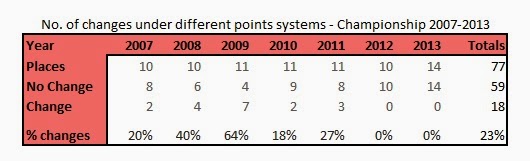
We wholly expect that the Leeds Met research group will have looked at the same sort of stuff that has been trotted out by us and others in terms of the impact bonus points have had on league standings. They'll find three-quarters of final placings don't change, and the pivotal spots are rarely influenced, by how you count your points from recent experience in the Championships.

Between 2007 and 2013, inclusive, there have been only 18 positional changes in the final Championship league standings comparing what things would be like under the 3/2/1 system and the 2/1/0 system. 77% of league positions didn't change. In this period, the top and the bottom spots were never affected by position changes in the Championship.

A similar position is seen in Championship 1 (where we only had data from 2009). 12 changes mean 76% of all league positions didn't change depending on what point system is used. Again, no change in the top spot was seen and what will be the play off positions were hardly affected either.

In Super League, where we're looking from the other side as no bonus points were used, there would be more positional changes depending on which system you use. 32 changes that means a smaller proportion of positions would stay the same, at 66%.

What we hope the RFL researchers will also consider is not how well the bonus points have actually achieved their objective - to give an outcome of closer, so in theory more exciting, games. We will now present our (admittedly slightly limited and straightforward) analysis of this objective.

We could only get reliable data going back to 2004 for the Championship. We have full results for three seasons before bonus points and seven completed seasons up to 2013 since. We have full Super League data dating back to 1996 inaugural summer campaign but we're only using from 2004 for consistency. Although the bulk of our data came directly from the RFL we hope they have had more long ranging records to provide the Leeds Met team with to allow them to make more robust conclusions. (If anyone wants to send us full results from the semi-professional ranks dating back to the start of Super League we would be very grateful!)

For this we took the 12 point margin bonus point achieving results to be close and games that ended with a margin of greater than 24 points to mean they weren't close, they were big defeats.

Looking at the Championship in isolation first, in the three seasons shown where bonus points weren't used 38.7% of games would actually have seen one earned if they were on offer. 28.6% of games in that three year period were defeats of over 24 points. Over the seven bonus point seasons themselves, 42.5% of games have earned a bonus point and 30.1% of games have ended with a wide margin between the teams. This supports the theory that the bonus points system leads to more games finishing close on the scoreboard, which is it's main aim surely. However, somewhat of a contradiction is that more games have finished up with a one-sided scoreline since bonus points came in, compared to before. This indicates that bonus points may not necessarily be the most useful way to produce competitive games.

As you can see, a higher amount of close games and a lower amount of big defeats have been seen proportionately in Super League than in the Championships over the ten year period looked at. This is despite bonus points being used in seven of those ten Championship campaigns. It suggests that Super League, in general, has always been a more competitive league than the Championship has been. 

Incidentally, on Super League, during the ten years shown above five were a 12 team competition and five were a 14 team competition. In the 12 team years 2004-2008 we saw 45.8% of losses end as a 1-12 point margin and 25.6% end with 24+ point margins. In the 14 team years 2009-2014 those numbers were 41.3% and 28.1% respectively, indicating that the 12 team league will result in more close games in itself .

(2014 numbers so far would make the 14 team figures look even worse comparable to the 12 team numbers above - the one caveat to that is 2013 and 2014 have both seen more draws than in any other Super League season, although the average draw proportion in the two periods is pretty much the same.)

Thanks for reading and we hope this has provided an interesting insight into the impact of bonus points. Keep you views coming in. Don't forget to listen to our show with new episodes released every Tuesday during the Super League season. All the links you need to expand your SLP involvement are in the sidebar.

23 August 2014

#RLNewEra - Dual Registration

One burning and seemingly unresolved issue is that of Dual Registration. That marriage of convenience between two clubs that seemingly no one really wants to embark on but circumstances have often made it necessary and even fit some worthwhile.

Here's what the Q & A says (not a great deal!):
Q. Will Championship and League One clubs still be able to enter into dual registration partnerships with Super League clubs?

A three-way working party with representatives from Super League, Championship and the community game has been formed to look into how best to protect the integrity of the leagues whilst ensuring that there are minimal barriers to stop players having regular competitive playing opportunities.
We do know a bit more than this though. From what has been said on the press we expect it to be retained in 2015 at least, but the number of players a dual reg club can field each week  will be cut to three, and no dual reg players will be allowed to feature in the all important Super 8s stage, when promotion and relegation actually gets decided in the New Era.

Dewsbury have come out and said they aren't looking for a dual reg relationship in 2015. You can't expect that Bradford, London and Leigh will have one as they will operate full-time with the idea of having a club fit for Super League itself central to their thoughts. Featherstone are traditionally against it and unlikely to continue with it. Halifax don't use the system and question marks have to be raised over what Doncaster and Batley might do have been burnt by dual reg small print this season.

Before we give opinion on this, let's examine what dual registration is, or at least had been, during it's relatively brief existence.

“Dual Registration” is the system whereby a Super League Player continues to be registered to and be eligible to play for his current Super League Club and is also registered to play for a Championships Club. 

The purpose of this Rule is to provide an enhanced Player development pathway for young Super League Players who are not thought to be ready to make the step up to Super League first team on a permanent basis but for whom first team match experience in the Championships is likely to be beneficial for their development. It is intended to provide additional flexibility for Clubs to make arrangements that suit the Player’s development needs whilst protecting both the playing squad requirements of the Clubs concerned and the integrity of both competitions. The purpose of this Rule will be taken into consideration if an issue arises that is not expressly provided for in these Rules.
The rules in short are that an approved DR partnership must exist between the Super League and non-Super League club. Only players aged 18 and over with appropriate visas can be dual registered. No more than five combined DR and loan players can feature in a Championships club match day 17. There are then of course the newly high profile rules about playing 3 games by the registration deadline to keep being DR eligible of earning over £20k. More comprehensive details are found in the RFL Operational Rules.

So what's the SLP take on this? Well here's Mark's view.

Let's be frank, our talent pool is fairly thin and even thinner is the depth of funding that allows for widespread professional environments for our talent to develop in. For that reason I always thought DR was a good thing in theory.

In practice it's been a bit different. I'm no fan of it being used simply to get established first teamers back to fitness. The main controversies coming through the Warrington-Swinton link up, but it has happened elsewhere from time to time. I also don't really like it being used for the championship clubs taking whatever they can get week by week with their own contracted part-time players missing out at the last minute.

Some sort of balance needs to be struck if the system is to stay long term. In my view their should be a maximum dual reg player age as well as a minimum. The other option is the parent club can only identify 10 players in their squad who can be taken on dual reg in the season, maybe with the chance to review that list half way through.

The other factor to consider in the new era is that the structure could in theory mean dual reg linked clubs play each other. The solution at the moment is that dual reg can't be used in the Super 8s. In my view the ultimate objective of the new era should be to create an environment where more clubs can develop off the field to work towards full time set ups where they have their own production line and squad depth. The continued existence of dual reg somewhat undermines that idea, although let's face it, so does the way funding works and the inclusion of promotion and relegation with the third tier.

My answer would be to remove it from the Championship and only use dual reg at League 1. Resources there are very low but the level of competition is still pretty high. The Super League players aged say 18 to 23 will get a chance for senior competition that they can grow in whilst they are still cementing their place at the top level. The poor clubs get the benefit of rich club's players to fill their own gaps come injuries or suspensions.

Something may have to be done to allow more freedom or flexibility in the loan system for Championship clubs but I suppose that's another matter.

What about what you guys have said:
kev critchley @wembley98: @SuperLeaguePod no dual reg. better off scrapping back to loans only
justannie @annieandmorris: @SuperLeaguePod no dual reg. 
London Faithful ‏@LondonFaithful: @SuperLeaguePod I think we should make dual reg for players 21 and under and you have to be at the club for 2 games minimum. 
IAN GATWARD @gatwardian: @SuperLeaguePod dual reg system is there for abuse especially when the divisions get split

Keep your views coming in, we love to hear from our readers and listeners. And don't forget, keep listening to our show and sharing it with your friends and followers on Facebook and Twitter.

10 August 2014

#RLNewEra - Salary Cap and Central Funding

Last time we covered off how the Challenge Cup will work out in the new structure. Now we're turning our attention to something less clear cut and surely more controversial - heck, its been controversial for long enough already it didn't even need the restructure to stir things up!

The salary cap in the Super League has been a source of much recent debate, with some wanting to scrap it, many wanting to tweak it, and others giving it their full backing to remain as is. Funding is another issue that is central to the whole idea of having a salary cap.

Here's what the RFL New Era Q&A said on these topics:
Q. What changes will be made to the salary caps for Super League and Championship clubs? A. There will be no change to the Super League Salary Cap Regulations in 2015.The Championship Salary Cap regulations are substantially changed for 2015. The major changes to the Regulations are:The move to a “live cap system”. This represents a significant change from the approach taken under previous salary cap regulations, in that compliance is now to be monitored on a ‘live’ and ongoing basis, enabling breaches to be investigated, determined and sanctioned without delay.The increase in the Finite Salary Cap to £1 million. 
Q. How will the financial distributions change to facilitate the return of meaningful and sustainable promotion and relegation? A. The change in structure has seen a significant increase in the central funding available to those clubs relegated from Super League in 2014 and the top clubs in the Championship in 2014. This should allow for more full-time professional clubs in the championship competition in 2015, ensuring that the gap between the teams in the Super League and the Championships is narrower than ever before.
Q. Will the clubs relegated from Super League receive a ‘parachute payment’? A. No, but there is increased annual central funding to those clubs relegated from Super League in 2014.
Q. What changes will be made to the way in which clubs are funded? A. There is a widespread recognition that the return of meaningful and sustainable promotion and relegation between the sport’s two competitions requires significantly increased investment in the Championship. A Championship club receiving a share of central distributions at current levels would have little chance of competing against Super League opposition over a sustained period. The new structure allows for that increased investment and sees the best performing Championship clubs receive up to £750,000 per season from 2015, which will enable them to recruit a competitive squad and invest in the player development pathways needed to achieve sustained success. The top Championship clubs will also receive funding increases at the end of 2014. League 1 clubs will also receive an increase in central distributions and face a more flexible salary cap that allows them to spend an additional £100,000 per season (as long as the total does not exceed 50 per cent of turnover) if they can provide evidence that the spend is manageable.

Here's what Mark makes of all this:

First of all I'm a fan of salary caps in sport as a general position. Some of the most competitive and enjoyable sports leagues have them. They aren't, as some critics will say, a mechanism for bringing the the top clubs down to the level of the bottom clubs. They should in theory even out the talent distribution to a greater or lesser extent depending on how they are organised, so that no one club can stockpile all the best talent and all clubs should have a number of high quality players. Poorer players playing with better players can help improve their game. Closer standards should lead to a greater level of professionalism and intensity. This should then advance the league with the salary cap, with a gradual increase in talent league wide. That should, as seen in other sports leagues outside ours, start to increase interest, sponsorship, revenues and the ability to attract more talent in to the game - so the cap level can increase along the way.

For salary caps to work at their best, though, you really need equal funding at least to give all teams the ability to spend close to the same. Without that, talent and intensity remains unbalanced. Sound familiar?

I would have preferred some increase in the salary cap personally. I'm not talking about a massive lift, I accept at the moment that isn't financially viable. But we can't have a cap that is, although slightly remodelled, effectively the same as it was a decade ago. 

The main reason for me thinking there should be an increase is simply that there are more games to be played next year. Excluding the cup which is hard to guess how many games each team will play and an expanded World Club Challenge, we're still going to see an increase in the average amount of games clubs at all levels will play next season compared to this. In Super League teams on average will play 2 more games than in 2014. It translates to an 8% increase in games, so why not an 8% increase in the cap - that would take it to £1,971,000. 

It strikes me as unfair on clubs (and/or players) that they need to play more games but can't sign more players without forcing pay cuts (or play more times for the same money). 

From the club's perspective, if you have to manage more games on the same cost of playing squad then you will possibly have to lower quality for greater quantity to cover injury, or it may force the greater use of players not really fit, a player safety and welfare issue.

From a player's perspective, I'm not saying that the average Super League player isn't better paid than the average Super League supporter, but if you were told you would possibly have to do more work (however privileged you feel to do that work) for the same money (however good that money is) you probably wouldn't be happy. You may even look for a career change. It could encourage top players away from our league even more than the relatively low cap already might be doing.

I would also introduce a marquee player rule (though I don't like that particular name for it). I've spoken about it on the show and written before on the topic. Having one - or even two or three off-cap players, as long as their is a contributory aspect that encourages home grown players available for England selection (or France, or other home nations of course) - can only be a good development for the sport and the league. I've shown that it shouldn't have a massive skew on competitive balance previously and if you restrict them to clubs/owners who can financially support them then it won't impact the financial sustainability aims of the New Era. 

Regarding the impact on competitive balance, my response to this would be one player doesn't make a team. When Warrington signed Andrew Johns for the season climax in 2005 they didn't win the league, they lost heavily in the first playoff round. Wally Lewis' spell at Wakefield in 1983-84 didn't stop the club from being relegated that year. Outside rugby league, Ballon d'Or holder Cristiano Ronaldo's Portugal couldn't make it out of the 2014 Soccer World Cup group stages and NBA league MVP LeBron James wasn't enough on his own to even win any conference titles with Cleveland, before joining a dream team set up at Miami. Because of the restrictions that will apply, the biggest wallet can only buy so much still, but what it can buy (or retain) might have that little bit more star quality.

Regarding the financial aspect, I would point out you don't have to sign a high salary marquee player if you don't want to or can't afford to. Many teams reportedly already don't pay to the full salary cap limit yet knock off other teams in a pretty close and full of surprises Super League XIX. Rugby League fans by and large, I'm sure, accept the financial realities their club faces and would accept if their club can't afford a big name. Especially if the rule means the league can grow a bit, attract some new investment and sponsorship, which will potentially benefit their team too (as long as they aren't relegated!).

The reintroduction of the 50% revenue clause is a good step in regards sustainability. What isn't clear is if there is a cap on the amount of money owners can contribute from their own pockets - I asked the RFL if there is a limit on that (there is under the Football League's financial fair play regulations for example) but didn't really get an answer. However, if cash rich owners at revenue shy clubs can personally underwrite the cost of marque players (Marwan, I'm thinking of you!) then I don't see a problem with it.

Then, outside Super League, there is a big change. A change that you have to say was needed in a return to promotion and relegation. It should be quite clear I'm not in favour in general of this, but to be fair to this new system, there is a degree of sustainability in the logic of the new and frankly tough pathway that is set for any club to enjoy a spell at the top level. We've seen the odd cup upset over the years where part-time Championship clubs with a maximum allowed spend of £400,000 (if special dispensation was awarded) topple Super League opponents, but to compete over effectively a quarter of a season there would need to be better parity in spending ability, so the increase to £1,000,000 for Championship clubs makes sense. Of course, with the 50% revenue clause all 12 won't be able to spend to that level. That actually sort of leads neatly to funding, because this is where eyebrows for me are raised as to whether anyone has fully thought through this new structure.

Average Championship crowds between 2004 and 2012 (the years I have the best info for) were 1,763. Limited, although at least some again, TV coverage definitely impinges on sponsorship earning potential. The central funding will be a maximum of £750,000 for the foreseeable future (although its £788,000 and £787,000 for Bradford and London for 2015). The sliding scale looks to be £750,000 down to £150,000, with the majority getting closer to £150,000 that £750,000. In short, revenue generation in the second tier will not be great. It seems unrealistic that the 2015 'Qualifiers' will feature anyone outside the two relegated sides and the sides that finish in the top two or three of this season's Championship.

We now have 14 full time clubs and should have at least 16 in 2015. How many more could afford to join that number with the way funding is laid out is questionable. I would also ask how long it is sustainable if the reality we see is little movement between the top two divisions. 

And then if you drop to League 1 - which two clubs will do each year - you find yourself with a salary cap limit of £200,000 and central funding of around £75,000 from the TV deal. Any benefits you've developed from the Championship times will be gone surely. Any youth you've brought through or coaching staff you've developed will be at serious risk of being lost from the club before finishing the job of securing a strong full time future.

It makes me wonder what the objectives really are and whether that has really been understood in this 'whole game approach'. Of course, I'm painting a somewhat worst case scenario, that supports my anti-P&R viewpoint, but remember two clubs will go down to League 1 every year, but no clubs are guaranteed to go up to Super League. When you flip it around like that I wonder if the sustainability, growth and development that the above RFL answers suggest is really in-built in the new system.

I'll talk now briefly about the One Million Pound Game in all this funding. Giving it that title, bestowing it with so much financial significance, really emphasises that there is still a large funding gap. A massive disparity. And if the RFL don't effectively run the 50% clause, like you might argue they didn't effectively police licensing, then we could still see overspending and an arms race element to things that undermines the whole process. Again, this is worst case, and I genuinely don't want this to fall flat on its face in failure. I don't want my prophecies to be realised. I just hope all the ducks are in a row and any lessons of the past have been well and truly learned.

As we're getting this now (and so should fully back it whilst its there!) its kind of irrelevant what I would do. I would say the most successful changes or additions to the top league have been the carefully thought through, planned and prepared ones - the introduction of the Catalan Dragons and the accession of the Widnes Vikings being the prime examples. If I was going to tell you what I would do it would involve greater central planning and much wider sharing of revenues, resources, expertise and information - it is the sport/leagues that is competing with other sports/leagues much more so than it is the teams competing against each other, that is something we should never lose sight of, but that is another much longer story that I will one day write in full I'm sure.

Ultimately, I'm all for giving the structure a chance and I'm all for salary cap regulations. I'm just not sure we've landed on what cap is best for the immediate future or, more importantly, addressed the funding issue yet. That is the key to sustained success, not what system we play under. Someone at the top needs to understand that, someone who can get all the others to buy into that mindset. What use is an outstanding product that you can't afford to package and sell properly.

Hopefully you've enjoyed Mark's thoughts on this part of the New Era announcements. In time we'll add Tom's contribution on this topic. 

We also want your thoughts too - it isn't something we got much input on when we asked on social media, which is surprising given its importance and relevance to the future of our sport. 

Give us your thoughts on Twitter or Facebook (links in the sidebar) and we'll add them in, or why not just leave a comment. And whatever you do, don't forget to keep listening to the show where we'll be filling you in on any changes and updates in the New Era every week on Super League Pod!


20 May 2014

The Future for Championship 1

Just like over at Red Hall, we at Super League Pod are keen on a whole game approach. With that in mind Mark has given some time this week to thinking about the future of our third tier, currently known as Championship 1.

Torch bearer of all things RL Championships related Gareth Walker recently revealed the proposed options for the third tier in the publication he edits, Rugby League World (and then again in sister publication League Express). So, many of you should have seen these by now.

There are three options that the clubs have been given to consider:

(1) A straight home & away 26 game league season. Top would be promoted to tier two along with the winner of a four team playoff for the other promotion spot.
(2) A 22 game league season with the same promotion & relegation method used, together with a 16 team cup competition including National Conference league and cup winners.
(3) A 20 game league season, with the same cup competition as above, but different playoffs. 1st would play 2nd, the winner getting promoted, the loser joining 3-5 in a four team playoff to decide the other promoted side.

Walker suggests that the clubs are keenest on option (2). On the face of it, it is the most sensible - it keeps a good number of games, whilst not being too complicated, along with having a few options for success that teams have to play for.

The first thought that occurred to me was how much excitement would the cup competition being if you're essentially going to be playing against the same teams you do in the league? It would be great for the two amateur clubs, but would fans really care? Would the fixtures become stale and repetitive? I think there is a real possibility of that.

There are two ways of livening it up, but they will not come together sadly.

Firstly, a great incentive would be to put the final as a Challenge Cup final curtain raiser (let's face it, no Champ 1 team will make that game in this era). A chance for clubs and players at that level to get the Wembley experience would be massive.

Secondly, however, it would be an opportunity for some clubs to keep their season alive, especially with it being a 14 team comp but only 5 teams seeing promotion possibilities at the end of the regular season. The 'however' is because the Cup final is likely to move forward (as we've said before, first Saturday in June would be ideal, but May is more likely). This means the cup competition can only be a Wembley curtain raiser of its played mid-season, when everyone's season is still alive.

Something fair to say is that what they have come up with isn't particularly radical and innovative, which may well come as a rare relief for rugby league fans!

One thing is now for certain, the third tier isn't being completely bypassed by the restructure, even if they are being financially sidestepped from taking rewards from the new TV deal.

The RFL and the Championship 1 clubs have to strike the right balance and find the best way to come up with an interesting and affordable way forward.

We'd love to hear your thoughts on what the best option to take might be and any ideas you might have that the powers that be haven't come up with. Leave a comment or get in touch through the normal social media routes.

Thanks for reading, and don't forget to listen to the show!

12 April 2014

Championship Week - Whitehaven: Looking To Avoid The Drop

Following on from the piece on Sheffield Eagles, we're continuing our look at the Championships with the assessment of Whitehaven fan Lee Carson on his team's fortunes.

The target has to be to avoid the drop this season and so far it has been a mixed bag of results.

A defeat at Keighley without bonus point followed by postponement of Crusaders game didn't help. An excellent win at Dewsbury and a poor second half against Halifax again with no bonus point.

A shocking cup defeat at York after being in control seemed to indicate a struggle this year but a good win against Barrow has helped improve matters.

The signing of Brett Seymour, visa permitting, is excellent news and a big boost. We need to win all home games against the lower teams and start to pick up some bonus points along the way and if we perform consistently then we have a chance of avoiding the drop.

Dual Registration for all clubs will have a big say in the bottom half of the table as it will be that tight based on the games so far.

Thanks for reading
Lee Carson @jameater5

Thanks to Lee for giving us his thoughts. If you're a Whitehaven fan, do you agree or have anything to add? Get in touch!

If you're a fan of another club in the Championships and wasn't to contribute a piece on your club then get in touch on Twitter, Facebook or by email to superleaguepod@gmail.com

And don't forget to listen to the show!

9 April 2014

Championship Week - Sheffield Eagles: A Season That Might Not Have Been

This week at Super League Pod we're having a look at the Championship based around our trip to see in form Halifax host top of the table Leigh. As we aren't fans at Championship clubs (not yet anyway for Tom) we're looking for all the input we can get from you guys.

Here's the first offering we've received from Sheffield Eagles fan and friend of the show Scott Quibell:

Here we are five league games into the season, a slow start for the Eagles (nothing new) but the Challenge cup third round win over amateurs East Leeds seems to have kicked started our season. A 46-10 demolition of Dewsbury was followed up by a 42-24 win away at Keighley and then another points fest 70-28 against London Skolars in the challenge cup 4th round. 

We certainly seem to be finding our feet at Owlerton stadium now. It's a very small pitch so it was always going to take a bit of time to adjust, but it could have been a very different story and possibly dare I say it a new season without the Eagles at all.

Rewind to Friday 6 September 2013 and the first round of the Championship playoffs versus Halifax at Don Valley. The Eagles were well beaten that night 21 points to 6 by a very good Halifax side that kept our attacking flair very quiet, something not many sides managed to do last season. As I arrived home disappointed by the result news started filtering through that the plan for the club's new home for next season - a university sports complex on Bawtry Road just off the M1 - had fallen through and the club now had nowhere to go having exhausted all options within the city. Mark Aston went on radio Sheffield to address the fans of the now dire situation, which can be listened to here.

All in all it was an awful night that I'll never forget for all the wrong reasons. Where could the club go? The football clubs didn't want to know. Woodburn Road (Don Valley's replacement) was ruled out, the pitch at Sheffield FC's home at Dronfield was too small for Rugby League.

Then Owlerton Stadium, an option which had been ruled out due to lack of facilities, stuck their hands up and the ball was rolling. A lot of work was needed, the changing rooms needed sorting and the pitch was in a state, but if these things were sorted the RFL would give it the green light. Thankfully it all came off.

And after that disastrous night against Halifax, when all looked lost, we went on all the way to Grand Final glory which was real test of character for the lads with all the uncertainty. As they say the rest is history! Strangely the Grand final was the same day Don Valley closed it's doors forever. It wasn't ideal for Rugby League but it had been our home for 23 years it still feels a bit strange knowing I'll never be going back there. 

On we move and I went into this season full of relief, the club has had a major upheaval and I can't thank the guys down at Owlerton enough for what they have done for us. And as for this season? I couldn't care less if we finished first or much further down the table as I for one am simply glad to still have a club to support for many years to come.

Thanks for reading
Scott Quibell @ScottQuibell85

We hope you've enjoyed Scott's insight on his Eagles. If you want to share your Championship or Championship 1 early season stories then contact us on Twitter, Facebook or send it over by email to superleaguepod@gmail.com